On a personal note, my best moments of the decade were meeting my future wife, getting married, my children being born, and the Nats winning the World Series in chronological order.
The worst moments were my mom having a heart attack and election night 2016. There were also low moments at the start of the decade when I was going through moments of personal discovery.
All in all, this was the best decade of my life.
Showing posts with label sp. Show all posts
Showing posts with label sp. Show all posts
Tuesday, December 31, 2019

Sunday, August 19, 2007
I Hope
I hope to go to Iraq one day. I want to find someone affected by the war, give them a hug, look them in the eye and say, "I'm sorry."
Wednesday, August 01, 2007
Flying Over Baghdad
On my flight from Kuwait to New York, I passed by Baghdad. From 30,000 feet above, the people looked like an insignificant abyss of nothingness. Evidently the view’s not much different from the Oval Office.
Monday, September 11, 2006
Out of the horrors of the Holocaust, two generations later, I have a wonderful life. This doesn't make the Holocaust itself good, but good can come from tragedy. Perhaps it is the hopeless optimist in me, who wished that out of tragedy of September 11, 2001, this world would have become a better place. I'm reminded of the words of Martin Luther King, "Only when it is dark enough, can you see the stars." But five years after the attacks on September 11th, the legacy of that day is seemingly never-ending violence.
The victims' families' pain has been public and even political. America is not a society that deals well with others' grief. The impetus to "get on with you life" is great. "Get over it." We are implicitly told that five years is enough time to grieve and move on passed the loss of a loved one, but not enough to move passed an attack on our homeland.
It is understandable that people- who, frankly, are not connected to the attacks on September 11th- will grieve for people of the same imagined community. They will go through the standard steps of grief. But let there be no doubt that your grief is less important than those who lost loved ones on that fateful day. You have a right to be sad, to be angry, to feel guilty, and to experience all of the emotions that are accompanied with loss, but these attacks did not take away your kid, your dad, your mom, or any other loved one. We Americans are selfish grievers, but your grief needs to take a backseat to those who have actually lost.
There is a unique wisdom that tragedy provides. Some choose to explore that wisdom, some choose to ignore it. But this country has failed to listen to the people who were directly affected by the attacks on September 11, 2001. Instead, we listen to politicians and pundits, who interpret the pain of others. They did not experience any tangible loss and they have no right to claim that date as their own, for their own causes.
Over the last five years, there has been plenty of murder, with vengeance as justification. We must stop the cycle of violence; it is America's responsibility.
The victims' families' pain has been public and even political. America is not a society that deals well with others' grief. The impetus to "get on with you life" is great. "Get over it." We are implicitly told that five years is enough time to grieve and move on passed the loss of a loved one, but not enough to move passed an attack on our homeland.
It is understandable that people- who, frankly, are not connected to the attacks on September 11th- will grieve for people of the same imagined community. They will go through the standard steps of grief. But let there be no doubt that your grief is less important than those who lost loved ones on that fateful day. You have a right to be sad, to be angry, to feel guilty, and to experience all of the emotions that are accompanied with loss, but these attacks did not take away your kid, your dad, your mom, or any other loved one. We Americans are selfish grievers, but your grief needs to take a backseat to those who have actually lost.
There is a unique wisdom that tragedy provides. Some choose to explore that wisdom, some choose to ignore it. But this country has failed to listen to the people who were directly affected by the attacks on September 11, 2001. Instead, we listen to politicians and pundits, who interpret the pain of others. They did not experience any tangible loss and they have no right to claim that date as their own, for their own causes.
Over the last five years, there has been plenty of murder, with vengeance as justification. We must stop the cycle of violence; it is America's responsibility.
Friday, August 25, 2006
Back Home
Perhaps one day I will look back and decide that this trip changed my life in a very profound way. Or it will be lost in the immense landfill that are my forgotten memories.
All summer long I've had a low opinion of myself. This trip helped to intensify that feeling and, hopefully, flush it out. Perhaps this was apparent between the lines of my posts, I'm not sure.
For someone who is quite self-conscious about how little he knows and struggles with the paradox that the more I know, the more I realize I don't know, this trip was devastating. I encountered languages that I will never learn and thus people I will never know. I went to different countries and my mere presence demanded that they know my language.
I realized that almost all of the people I came across were better people than I. I'm reminded of the Syrian Muslim in Sofia, the Moldovan woman on the train to Bucharest, Mike's family, and Patricia's family. These people have touched me in a profound way with their kindness, in a way that I can never repay. And how did I repay them? With arrogance and ignorance.
My 3 most rewarding experiences:
In chronological order: Visiting the beautiful synagogue in Sofia and praying in the mosque there across the street with Sherkhan. We also visited an Eastern Orthodox church. Especially the synagogue and the mosque (because I wasn't with a Christian) gave me a warm feeling. It showed me the good that can come from understanding and acceptance.
In Vienna, striking up a conversation with some guys from Africa. In a few short hours they allowed me into their world while exploring mine. It was a situation that many idealists dream of. People from different walks of life sitting around and learning from each other's experiences.
Patricia's country house is near Mlawa, Poland. Mlawa (pronounced Mwa-va) is her hometown. We walked through the forest together talking. It was a blessing to be able to connect with someone so special. Unfortunately we had many miscommunications, which I blame myself, but that day was something that I will cherish always.
It will be liberating now for me to go back to talking about things other than myself.
For Americans, some of Eastern Europe's culture can be offensive. We saw many teens stick their tongues down each other throats in public. I'm all for making out with someone you love, let's just keep that between you and your loved one. Also, men pop their collars way too much. Also, where were my free refills, ridiculously sized meal portions, and 3.5 gallon flush toilets?
All summer long I've had a low opinion of myself. This trip helped to intensify that feeling and, hopefully, flush it out. Perhaps this was apparent between the lines of my posts, I'm not sure.
For someone who is quite self-conscious about how little he knows and struggles with the paradox that the more I know, the more I realize I don't know, this trip was devastating. I encountered languages that I will never learn and thus people I will never know. I went to different countries and my mere presence demanded that they know my language.
I realized that almost all of the people I came across were better people than I. I'm reminded of the Syrian Muslim in Sofia, the Moldovan woman on the train to Bucharest, Mike's family, and Patricia's family. These people have touched me in a profound way with their kindness, in a way that I can never repay. And how did I repay them? With arrogance and ignorance.
My 3 most rewarding experiences:
In chronological order: Visiting the beautiful synagogue in Sofia and praying in the mosque there across the street with Sherkhan. We also visited an Eastern Orthodox church. Especially the synagogue and the mosque (because I wasn't with a Christian) gave me a warm feeling. It showed me the good that can come from understanding and acceptance.
In Vienna, striking up a conversation with some guys from Africa. In a few short hours they allowed me into their world while exploring mine. It was a situation that many idealists dream of. People from different walks of life sitting around and learning from each other's experiences.
Patricia's country house is near Mlawa, Poland. Mlawa (pronounced Mwa-va) is her hometown. We walked through the forest together talking. It was a blessing to be able to connect with someone so special. Unfortunately we had many miscommunications, which I blame myself, but that day was something that I will cherish always.
It will be liberating now for me to go back to talking about things other than myself.
For Americans, some of Eastern Europe's culture can be offensive. We saw many teens stick their tongues down each other throats in public. I'm all for making out with someone you love, let's just keep that between you and your loved one. Also, men pop their collars way too much. Also, where were my free refills, ridiculously sized meal portions, and 3.5 gallon flush toilets?
Thursday, August 24, 2006
Visiting My Family's Past
It was four hours into an 18 hour bus ride from Warsaw to Munich. We pulled into a bus station and Meet the Fockers, dubbed in monotone Polish, disappered from the bus's tv screen. I looked outside and saw a sign that said "Koninski". I got up and walked out of the bus.
"Konin" "Konin" "Konin." It seemed to be on every sign. I ran over to a map and sure enough "KONIN" was in big capital letters in the center of the map. I was in Konin.
My grandfather grew up in Konin, Poland before the Holocaust. He was the only member of his family to survive. He never went back to Konin. But he kept a book written in Hebrew about the town with him until he died.
I ran back onto the bus and grabbed my disposable camera. I only had two pictures left. In my excitement\ anxiousness\ nervousness I took one of the ground. I composed myself and was able to snap a shot of a sign that said "Konin."
I put the camera back in my backpack and walked back outside. The faintest drizzle fell on me. I was surrounded by creepy looking people smoking in a bus station. I tried to draw meaning from the bizarre situation. A very attractive girl made eyes at me, but I ignored her, she wasn't my type anyway. Even if she would have been, I still would've ignored her.
I felt trapped. I couldn't wander far from the bus. I couldn't explore my family's past. Or, probably more accurately, I wasn't able to find out what Konin was like without us. I walked back onto the bus in frustration, still not knowing what to do. I grabbed the cd that Patricia gave me of Jewish music in Polish, Hebrew, and Yiddish. I listened to her favorite song first and then the rest of the album.
Soon the bus began moving again and Meet the Fockers came back on the tv.
Now I'm in Munich alone, trying to grapple with everything. It's a horrible feeling to be here. It seems so surreal. Surreal in a nightmarish way. Why do I have to deal with this? I don't want to right now. Give me a break.
"Konin" "Konin" "Konin." It seemed to be on every sign. I ran over to a map and sure enough "KONIN" was in big capital letters in the center of the map. I was in Konin.
My grandfather grew up in Konin, Poland before the Holocaust. He was the only member of his family to survive. He never went back to Konin. But he kept a book written in Hebrew about the town with him until he died.
I ran back onto the bus and grabbed my disposable camera. I only had two pictures left. In my excitement\ anxiousness\ nervousness I took one of the ground. I composed myself and was able to snap a shot of a sign that said "Konin."
I put the camera back in my backpack and walked back outside. The faintest drizzle fell on me. I was surrounded by creepy looking people smoking in a bus station. I tried to draw meaning from the bizarre situation. A very attractive girl made eyes at me, but I ignored her, she wasn't my type anyway. Even if she would have been, I still would've ignored her.
I felt trapped. I couldn't wander far from the bus. I couldn't explore my family's past. Or, probably more accurately, I wasn't able to find out what Konin was like without us. I walked back onto the bus in frustration, still not knowing what to do. I grabbed the cd that Patricia gave me of Jewish music in Polish, Hebrew, and Yiddish. I listened to her favorite song first and then the rest of the album.
Soon the bus began moving again and Meet the Fockers came back on the tv.
Now I'm in Munich alone, trying to grapple with everything. It's a horrible feeling to be here. It seems so surreal. Surreal in a nightmarish way. Why do I have to deal with this? I don't want to right now. Give me a break.
Tuesday, August 22, 2006
In Warsaw, Poland
I've been in Warsaw for a couple days now and it's a nice city. It feels like America more than any other city I've been to on this trip. It's also been a different experience because I'm with my Polish friend Patricia all day.
Yesterday we walked into the former Jewish ghetto and she said, "We've been walking in the former ghetto for a little while now." I was taken aback at how matter-of-fact I perceived her statement. I didn't have time to prepare emotionally. But she didn't mean it to be matter-of-factly. She told me that it's just reality, it's there, so they are forced to deal with it, forced to come to terms with it. Her psychology classes are in one of the few buildings left in Warsaw from before the World War II and 1 of only 2 in the former ghetto that survived. It used to be where the Nazis tortured people. Patricia is the granddaughter of Holocaust survivors.
I met her family last night. They were so unbelievably nice. Her mom would say an English word and her and her two daughters would giggle. Patricia's sister Joanna is 19 and speaks English fluently and is clearly quite intelligent. One minute the mother and her two daughters are screaming at the top of their lungs at each other and the next they're laughing with each other. It's a site to see when you don't speak the language and you don't know what the fuck is going on.
Later I met Patricia's cousin George, who is a model. He is also 19, only about a foot taller than me, and was very eager to practice his English with me. He got his ideas across with ease, but struggled to master sentence structure. I really admire the ability to speak more than one language. I feel confined by English although people really do speak it in most places around the world. The entire family speaks more than one language.
Yesterday we walked into the former Jewish ghetto and she said, "We've been walking in the former ghetto for a little while now." I was taken aback at how matter-of-fact I perceived her statement. I didn't have time to prepare emotionally. But she didn't mean it to be matter-of-factly. She told me that it's just reality, it's there, so they are forced to deal with it, forced to come to terms with it. Her psychology classes are in one of the few buildings left in Warsaw from before the World War II and 1 of only 2 in the former ghetto that survived. It used to be where the Nazis tortured people. Patricia is the granddaughter of Holocaust survivors.
I met her family last night. They were so unbelievably nice. Her mom would say an English word and her and her two daughters would giggle. Patricia's sister Joanna is 19 and speaks English fluently and is clearly quite intelligent. One minute the mother and her two daughters are screaming at the top of their lungs at each other and the next they're laughing with each other. It's a site to see when you don't speak the language and you don't know what the fuck is going on.
Later I met Patricia's cousin George, who is a model. He is also 19, only about a foot taller than me, and was very eager to practice his English with me. He got his ideas across with ease, but struggled to master sentence structure. I really admire the ability to speak more than one language. I feel confined by English although people really do speak it in most places around the world. The entire family speaks more than one language.
Monday, August 21, 2006
Unexpected Rewards
Visiting and praying in the synagogue and the mosque in Sofia was one of the two most rewarding experiences of this trip. The other occured Saturday night. I was sitting on a bench alone in Vienna. Sherkhan was already in Milan.
I had nothing to do and I was exhausted. An old man got up from the bech and soon after two guys sat down. Another soon joined, standing by the bench. They talked to each other for about 20 minutes as I just sat there until we finally struck up a conversation. Soon a 4th guy joined us. 2 were from Togo and 2 were from Nigeria. We talked for several hours.
We talked about how black people are treated in Vienna and Europe on the whole and we compared that situation to what we have heard about being black in America. Basically, in Vienna, no one sits with a black guy on the subway, and elsewhere, they are ignored, scoffed at, and are forced to confront racist graffiti all the time. One man said he was tackled and booked by 6 police officers because they mistook him for someone else.
Black people cannot get office jobs, but these were 4 (definitely 3, 1 guy didn"t talk so much) of the most intelligent people that I've encountered on the trip. We talked about the difference between welfare, unemployment, education, and housing in Europe and in America. These guys were about 5-7 years older than me, so they knew what was going on a hell of a lot more than I do.
One guy told me that he had never just sat and talked to a white man, only the occasional white woman. I was pretty shocked by that. Personally, I really dislike small talk, but I would've thought that someone would've struck up a conversation with 1 of the 4 at some point. They didn't tell me how long they had been in Vienna, but all 4 spoke fluent German and they just said "a while." When we parted, we exchanged emails, which is further testament to how desparate these guys were to talk to someone. 1 guy said, "I want to talk to other kinds of people, but they don't want to talk to me." They've tried, I saw that just sitting there.
Now I'm in Warsaw visiting a friend. It's a neat city, but my friend either yells at me or ignores me, so that's not so great. Listen, I'm a schmuck, deal with it!
I had nothing to do and I was exhausted. An old man got up from the bech and soon after two guys sat down. Another soon joined, standing by the bench. They talked to each other for about 20 minutes as I just sat there until we finally struck up a conversation. Soon a 4th guy joined us. 2 were from Togo and 2 were from Nigeria. We talked for several hours.
We talked about how black people are treated in Vienna and Europe on the whole and we compared that situation to what we have heard about being black in America. Basically, in Vienna, no one sits with a black guy on the subway, and elsewhere, they are ignored, scoffed at, and are forced to confront racist graffiti all the time. One man said he was tackled and booked by 6 police officers because they mistook him for someone else.
Black people cannot get office jobs, but these were 4 (definitely 3, 1 guy didn"t talk so much) of the most intelligent people that I've encountered on the trip. We talked about the difference between welfare, unemployment, education, and housing in Europe and in America. These guys were about 5-7 years older than me, so they knew what was going on a hell of a lot more than I do.
One guy told me that he had never just sat and talked to a white man, only the occasional white woman. I was pretty shocked by that. Personally, I really dislike small talk, but I would've thought that someone would've struck up a conversation with 1 of the 4 at some point. They didn't tell me how long they had been in Vienna, but all 4 spoke fluent German and they just said "a while." When we parted, we exchanged emails, which is further testament to how desparate these guys were to talk to someone. 1 guy said, "I want to talk to other kinds of people, but they don't want to talk to me." They've tried, I saw that just sitting there.
Now I'm in Warsaw visiting a friend. It's a neat city, but my friend either yells at me or ignores me, so that's not so great. Listen, I'm a schmuck, deal with it!
Monday, July 03, 2006
Ask An Average Muslim
As with most Americans, I've been hearing and reading a lot about Muslims in the news for the last few years. The news has made me want to learn more about this strange and mysterious creature. So I decided to ask an average Muslim named Sherkhan, an American-born son of Pakistani immigrants, (who has been a friend of mine for years, considering he's come over to my house numerous times for Passover and I've observed the fast for the holy month of Ramadan with him, we went to college together and traveled to China since).
Our interview was conducted over email, because he is in Egypt right now.
Q: Are you a terrorist?
A: Well I do get pretty angry when my team loses in the Finals after being up 2-0 (see www.nba/mavericks/)
Q: Do you hate America?
A: No, I just hate pussies who blog about religions they know nothing about and then hide behind the anonymity of the Internet to escape the well deserved condemnation from their fellow Americans.
Q: Do you agree with al-Qaeda's aims?
A: No, they are a nihilistic terrorist organization that targets civilians and uses the banner of Islam to justify their atrocities. The Quran is a very explicit on the subject of suicide and the killing of innocent people. Commit suicide--you go to hell, no exceptions.
Q: What's up with those 72 virgins?
A: Its actually a translation thing. Arabic The Islamic scholar Yusuf Ali defines the word "Houris" in his English interpretation of Qu'ran as "Youths of perpetual freshness." He also described them in his commentary: "The companionship of Beauty and Grace is one of the highest pleasures of life. In this bodily life it takes bodily form. In the higher life it takes a higher form...The pronoun in Arabic is in the feminine gender. It is made clear that these maidens for heavenly society will be of special creation,-of virginal purity, grace, and beauty, inspiring and inspired by love, with the question of time and age eliminated." Women get the same deal.
A more complete explanation can be found at:
http://www.everything2.com/index.pl?node=72%20Virgins%20in%20Paradise
Q: What's your view on Israel?
A: I believe that Israel was created after the atrocities of WWII and that Jews were desperate to create a homeland of their own. I don't think its appropriate for countries to be based on ethnic /religious lines alone, even though that's how almost every country outside the Western Hemisphere is. Still, Israel's been there for 50+ years and time tends to legitimize things (I wouldn't want Pocahontas' ancestors launching a guerrilla war to drive me into the sea.) It's also remarkable how much territory they have returned after military capture (Sinai, Lebanon, Gaza) On the other hand the wall they have been building in the West Bank is turning it into an apartheid state. I could go on for pages, but to sum up: Israel should not be destroyed, Zionism is bad, all people should have freedom to worship in in Jerusalem.
Q: What's your view of Jews?
A: Jews are awesome. Where would we be without Whoopi Goldberg? --She's Jewish right? Actually Muslims revere Jews, Christians and Zoroastrians as peoples of the Book. The messages are generally the same, and Islam sees itself as a continuation of the Jewish and Christian messages. In fact, all Muslims around the world pray towards a house of God built by a Jew (Abraham).
Q: How do you feel about Christians?
A: Christians are great. I am most impressed with the volunteer and community service work that many churches do. Nuns are awesome. Whatever happened to that show where Sally Fields is the nun that can fly with that hat?
Q: Why were some Muslims offended by the Danish cartoons that depicted Prophet Muhammad as a terrorist?
A: There are a few main reasons: First, it is forbidden to show the image of the Prophet Muhammad (be it painting, sculpture, cartoon...) Second, not only was it the image of the Prophet, but it was a derogatory one with a bomb wrapped around his turban etc. Another thing is that most of the people in Muslim countries live under authoritarian governments, so 'freedom of speech' is not really acknowledge there--many people there think that if it got printed in the paper it must have had a government sanction/approval, even though there was nothing that the Danish government could do.
Q: Were you offended?
A: Hell yes I was offended. The cartoons are very derogatory, but what it does is highlight the double standards and thinly veiled racism that exists in Europe towards Muslims. Listen, we have a free press in America too, but just because you have the ability to offend and insult religions, doesn't make it right to do so. Most European countries guard and cultivate their culture, which is one of the reasons why its such a great place to visit. Part of the European identity is Christianity; being Muslim and being European seem to be mutually exclusive at this point (which is not the case in America).
Q: What takes place in a mosque during Friday prayers?
A: People go to the mosque for the middle prayer (Asr) around noontime. You listen to a sermon and then you pray together. The sermon can be given by anyone in the community, and often is coupled with the Imam's speech. The talks vary, from the importance of charity (zakat) or education, or chastity, or anything else you can think of.
Q: Do you still think Dirk Nowitzki is a good defensive player?
A: Yes, he is a good team defender. Rebounds and blocks are part of team defense.
So there you have it. While I did describe Sherkhan as "an average Muslim," he is only one person, not over one billion (the number of Muslims in the world). There are plenty of Muslims who know good defense when they see it.
Our interview was conducted over email, because he is in Egypt right now.
Q: Are you a terrorist?
A: Well I do get pretty angry when my team loses in the Finals after being up 2-0 (see www.nba/mavericks/)
Q: Do you hate America?
A: No, I just hate pussies who blog about religions they know nothing about and then hide behind the anonymity of the Internet to escape the well deserved condemnation from their fellow Americans.
Q: Do you agree with al-Qaeda's aims?
A: No, they are a nihilistic terrorist organization that targets civilians and uses the banner of Islam to justify their atrocities. The Quran is a very explicit on the subject of suicide and the killing of innocent people. Commit suicide--you go to hell, no exceptions.
Q: What's up with those 72 virgins?
A: Its actually a translation thing. Arabic The Islamic scholar Yusuf Ali defines the word "Houris" in his English interpretation of Qu'ran as "Youths of perpetual freshness." He also described them in his commentary: "The companionship of Beauty and Grace is one of the highest pleasures of life. In this bodily life it takes bodily form. In the higher life it takes a higher form...The pronoun in Arabic is in the feminine gender. It is made clear that these maidens for heavenly society will be of special creation,-of virginal purity, grace, and beauty, inspiring and inspired by love, with the question of time and age eliminated." Women get the same deal.
A more complete explanation can be found at:
http://www.everything2.com/index.pl?node=72%20Virgins%20in%20Paradise
Q: What's your view on Israel?
A: I believe that Israel was created after the atrocities of WWII and that Jews were desperate to create a homeland of their own. I don't think its appropriate for countries to be based on ethnic /religious lines alone, even though that's how almost every country outside the Western Hemisphere is. Still, Israel's been there for 50+ years and time tends to legitimize things (I wouldn't want Pocahontas' ancestors launching a guerrilla war to drive me into the sea.) It's also remarkable how much territory they have returned after military capture (Sinai, Lebanon, Gaza) On the other hand the wall they have been building in the West Bank is turning it into an apartheid state. I could go on for pages, but to sum up: Israel should not be destroyed, Zionism is bad, all people should have freedom to worship in in Jerusalem.
Q: What's your view of Jews?
A: Jews are awesome. Where would we be without Whoopi Goldberg? --She's Jewish right? Actually Muslims revere Jews, Christians and Zoroastrians as peoples of the Book. The messages are generally the same, and Islam sees itself as a continuation of the Jewish and Christian messages. In fact, all Muslims around the world pray towards a house of God built by a Jew (Abraham).
Q: How do you feel about Christians?
A: Christians are great. I am most impressed with the volunteer and community service work that many churches do. Nuns are awesome. Whatever happened to that show where Sally Fields is the nun that can fly with that hat?
Q: Why were some Muslims offended by the Danish cartoons that depicted Prophet Muhammad as a terrorist?
A: There are a few main reasons: First, it is forbidden to show the image of the Prophet Muhammad (be it painting, sculpture, cartoon...) Second, not only was it the image of the Prophet, but it was a derogatory one with a bomb wrapped around his turban etc. Another thing is that most of the people in Muslim countries live under authoritarian governments, so 'freedom of speech' is not really acknowledge there--many people there think that if it got printed in the paper it must have had a government sanction/approval, even though there was nothing that the Danish government could do.
Q: Were you offended?
A: Hell yes I was offended. The cartoons are very derogatory, but what it does is highlight the double standards and thinly veiled racism that exists in Europe towards Muslims. Listen, we have a free press in America too, but just because you have the ability to offend and insult religions, doesn't make it right to do so. Most European countries guard and cultivate their culture, which is one of the reasons why its such a great place to visit. Part of the European identity is Christianity; being Muslim and being European seem to be mutually exclusive at this point (which is not the case in America).
Q: What takes place in a mosque during Friday prayers?
A: People go to the mosque for the middle prayer (Asr) around noontime. You listen to a sermon and then you pray together. The sermon can be given by anyone in the community, and often is coupled with the Imam's speech. The talks vary, from the importance of charity (zakat) or education, or chastity, or anything else you can think of.
Q: Do you still think Dirk Nowitzki is a good defensive player?
A: Yes, he is a good team defender. Rebounds and blocks are part of team defense.
So there you have it. While I did describe Sherkhan as "an average Muslim," he is only one person, not over one billion (the number of Muslims in the world). There are plenty of Muslims who know good defense when they see it.
Tuesday, May 16, 2006
The Exploitation of September 11th
I had a frustrating teaching session with my students (I just want them to do well, but they didn't do all of their homework) and now I'm stuck in traffic. In front of me is a car with a license plate that catches my eye:
"1/18/1990 Never Forget"
That is the day my dad died. I become incensed. What right does this person have to remind me of my dad's death? How dare they trivialize him by putting his memory on a fucking license plate! I get out of my car and run to the one in front of me, open the driver's door, pull out the middle-aged woman and her 6-year old son and pummel them until my anger runs dry.
I'm at home now, bored. I'm just checking out other blogs. I find one blog with a drastically different slant from my own, no big deal. Then I see images flashing of the very moment that my father died. I can't control my emotions and write the purveyor of the blog a curt email.
Later, I get an itch to find out what's going on in the world. I turn on the news only to hear politicians invoking "1/18," (my dad's death!) for their own political gain. Sometimes I agree with the politicians, sometimes I don't, but what right do they have to use my father's death for their selfish reasons? For the next election, I write-in Mickey Mouse for every office.
My dad's legacy has become his death. His life has been forgotten by those fiercely claiming to remember him the most. No one cares about him. They simply use his death to strike fear in the rest of the country in order to scare everyone into compliance. I've lost the memory of my father. I've lost the control to honor him. My dad died in vain.
"1/18/1990 Never Forget"
That is the day my dad died. I become incensed. What right does this person have to remind me of my dad's death? How dare they trivialize him by putting his memory on a fucking license plate! I get out of my car and run to the one in front of me, open the driver's door, pull out the middle-aged woman and her 6-year old son and pummel them until my anger runs dry.
I'm at home now, bored. I'm just checking out other blogs. I find one blog with a drastically different slant from my own, no big deal. Then I see images flashing of the very moment that my father died. I can't control my emotions and write the purveyor of the blog a curt email.
Later, I get an itch to find out what's going on in the world. I turn on the news only to hear politicians invoking "1/18," (my dad's death!) for their own political gain. Sometimes I agree with the politicians, sometimes I don't, but what right do they have to use my father's death for their selfish reasons? For the next election, I write-in Mickey Mouse for every office.
My dad's legacy has become his death. His life has been forgotten by those fiercely claiming to remember him the most. No one cares about him. They simply use his death to strike fear in the rest of the country in order to scare everyone into compliance. I've lost the memory of my father. I've lost the control to honor him. My dad died in vain.
Tuesday, April 25, 2006
Two Girls Run Over By A Tank
It is 2002. Two thirteen year old Korean girls die. They were run over by an American tank in South Korea. This sparks Korean Americans to protest the presence of U.S. soldiers in South Korea, soldiers which have been there for five decades. For the rest of America, terrorism dominates everyone's thoughts. No one cares about these two kids. I don't.
It is 2006. I tutor some kids who came here from South Korea last January. I teach them English and have a continuous philosophical debate with myself over whether I am partaking in a form of colonialism or I am simply helping these people.
It is last Thursday. I give the students homework, "Write at least two pages of fiction and two pages of non-fiction." The oldest student, a boy of sixteen, finishes his non-fiction before class ends. It is only a half a page. I collect it and tell him to write another two pages of non-fiction for homework. I go to the bathroom to the sound of Korean spouted back and forth between a grandmother, her two daughters, and their three children, one of which is this boy.
I exit the bathroom and they're still yelling in Korean, but it could be anything as far as I know. As I put my shoes on outside of the house, the boy requests, with a nervous smile, "Non-fiction, you read, no angry."
"When I read your non-fiction, you don't want me to get angry?" I attempted to clarify. He shook his head yes.
Obviously, I was curious. On the drive home, I peeked at his writing. Just as I suspected, it was about America. It seems two girls were run over by an American tank. It would be five days until I could reassure him, "Yes, I'm angry! Not at you, but that it happened."
The transition to a new country is difficult. I couldn't imagine. I might be making that transition just a bit easier for him. He seems to re-enforce that sentiment with his smile and his willingness to struggle to learn this new language. He showed courage in writing about this tragedy, not knowing how I might react.
I got home and searched for the event and found it. Besides the boy's grammatical errors, his facts were incorrect. He had claimed that it took place in America and that the girls were eighteen years old. How to compliment his bravery, encourage his instincts, and yet correct his errors without damaging his spirit?
Damn. If only I got drunk, I wouldn't think about this shit so much.
It is 2006. I tutor some kids who came here from South Korea last January. I teach them English and have a continuous philosophical debate with myself over whether I am partaking in a form of colonialism or I am simply helping these people.
It is last Thursday. I give the students homework, "Write at least two pages of fiction and two pages of non-fiction." The oldest student, a boy of sixteen, finishes his non-fiction before class ends. It is only a half a page. I collect it and tell him to write another two pages of non-fiction for homework. I go to the bathroom to the sound of Korean spouted back and forth between a grandmother, her two daughters, and their three children, one of which is this boy.
I exit the bathroom and they're still yelling in Korean, but it could be anything as far as I know. As I put my shoes on outside of the house, the boy requests, with a nervous smile, "Non-fiction, you read, no angry."
"When I read your non-fiction, you don't want me to get angry?" I attempted to clarify. He shook his head yes.
Obviously, I was curious. On the drive home, I peeked at his writing. Just as I suspected, it was about America. It seems two girls were run over by an American tank. It would be five days until I could reassure him, "Yes, I'm angry! Not at you, but that it happened."
The transition to a new country is difficult. I couldn't imagine. I might be making that transition just a bit easier for him. He seems to re-enforce that sentiment with his smile and his willingness to struggle to learn this new language. He showed courage in writing about this tragedy, not knowing how I might react.
I got home and searched for the event and found it. Besides the boy's grammatical errors, his facts were incorrect. He had claimed that it took place in America and that the girls were eighteen years old. How to compliment his bravery, encourage his instincts, and yet correct his errors without damaging his spirit?
Damn. If only I got drunk, I wouldn't think about this shit so much.
Saturday, March 04, 2006
Hank Gathers
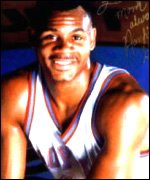 Today is the sixteenth anniversary of the death of Hank Gathers. Gathers was one of the best college basketball players in the nation for Loyola Marymount at the time of his death, March 4, 1990. Gathers died of heart failure.
His death had a profound impact on an eight year old boy, who had just lost his father in January of that year and who was just beginning to understand the finality of death. That an idol could also succumb to mortality was yet another lesson for the young boy.
Gather's high school friend, Bo Kimble, honored his fallen teammate through his play and his famous free throw technique, a left-handed shot, one which Gathers used to try to correct his game's one weakness.
While in China over this past May, in an unknown city in between Beijing and Shanghai, a jersey caught my eye. It was Bo Kimble's number 30 for Loyola Marymount, with a patch donning the number 44 on the shoulder, Hank's. I bought the jersey that falls to the floor when I put it on. But I didn't buy it to wear it. I bought to put in my room and remember a life that ended to early and a friend's noble attempt to memorialize him.
Sunday, September 11, 2005
Four years ago, the United States of America was attacked. What was attacked was the harm that our government's policies have caused. What the attack created was a sense of community among the people of this nation. Since the weeks following September 11, 2001, many Americans have stood behind the same government policies that initiated those attacks instead of upholding the ideal of community that was formed after the tragedy. We've watched our country go to wars that have not been sufficiently justified. We stood by and in many cases supported such endeavors. At times it has felt as if the people of this country did not retain the lessons that that horrible event provided us.
September 11, 2001 was one of the saddest days of my life. It changed my life in a very important way. But four years afterward, the victims have ceased to be remembered as the individuals that they were, but instead they have become pieces of political propaganda. While protesting the Iraq war, the protestors produced a rift in the rally, and I was stuck in the middle. Alone, with protestors far in front and lagging behind, a man came up to me and screamed with all of his heart, "Fuck you! Don't you fucking remember September 11th?!"
I remember.
September 11, 2001 was one of the saddest days of my life. It changed my life in a very important way. But four years afterward, the victims have ceased to be remembered as the individuals that they were, but instead they have become pieces of political propaganda. While protesting the Iraq war, the protestors produced a rift in the rally, and I was stuck in the middle. Alone, with protestors far in front and lagging behind, a man came up to me and screamed with all of his heart, "Fuck you! Don't you fucking remember September 11th?!"
I remember.
Monday, August 29, 2005
Four Shots One Evening
POP POP POP
I rose to peer out of the window.
POP
One man was dead, another man fled, and the witnesses were left with the thoughts swirling in each head.
It has taken days, but I now realize that there was much more in these two men's lives than what I saw, what I heard, what I felt. These men are more than their roles as victim and murderer. What led up to the murder? Not simply between these two men, but in their lives as a whole. We must not look for excuses or even reasons, murder should never be condoned, but simply gain a fuller picture. The victim was 21 years old. That is 21 years of moments just as the one that ended his life. The murderer, possibly a gang member according to newspaper reports, is also a victim. A victim of his own actions, his crime.
A maniac is confused. He wears a 'wife beater' and dark baggy jeans. He lowers his arm and runs in one direction for two steps. He changes his direction back toward his victim. He raises his arm in a panic and another POP resonates the parking lot. Then, in a flash, he is a blur. He gallantly, frighteningly runs to my right. Never to be seen again. He hopes.
A martyr lays on the concrete. He is purged of all his sins in a bloody mess. His feet point toward heaven. His right arm, decorated with a gold watch, rests peacefully on the ground. But the two morbid puddles of red tell a different story.
We are in shock, a frenzy, trying to find some semblance of calm for the sake of the others around us. The word that begins a million questions is 'why'.
Life changes in a second. But for both of these men, their lives had been leading up to this one moment. Nothing really changed. Every action that preceded that moment remains cemented in the stone of time. Only the way we relate to history changes. History does not.
The murderer, a man gone astray perhaps? Or perhaps he knew what he was doing. Perhaps he reached a moment of clarity before he pulled the trigger. This is what he was put on earth to do. To play the role of God for one brief moment. This was his destiny.
Maybe he really is a victim of society. Bad childhood. Parents hated him, if he had parents at all. This society breeds murderers through our own apathy. We view the people around us as 'others'. They're not our concern. This man fell pray to his circumstances. He could not change them. Sure, others have, but they were lucky.
I don't know. What I do know is that it is not that simple. It is not a case of 'either or'.
The victim, a man in the wrong place at the wrong time. Maybe he ran with the wrong crowd. Things spiralled out of his control. He didn't deserve this.
Perhaps he did deserve this. Perhaps he never had a way to lose. He was a bad man who finally got what was coming to him. He is yet another one that society forgot, because he didn't want to be remembered.
Again, it is not that simple. That is the way this incident will remain. A barrage of questions with little or no answers. A complex entanglement of 'perhaps's and 'maybe's that in the end signify not a whole lot.
POP POP POP
I rose to peer out of the window.
POP
One man was dead, another man fled, and the witnesses were left with the thoughts swirling in each head.
I rose to peer out of the window.
POP
One man was dead, another man fled, and the witnesses were left with the thoughts swirling in each head.
It has taken days, but I now realize that there was much more in these two men's lives than what I saw, what I heard, what I felt. These men are more than their roles as victim and murderer. What led up to the murder? Not simply between these two men, but in their lives as a whole. We must not look for excuses or even reasons, murder should never be condoned, but simply gain a fuller picture. The victim was 21 years old. That is 21 years of moments just as the one that ended his life. The murderer, possibly a gang member according to newspaper reports, is also a victim. A victim of his own actions, his crime.
A maniac is confused. He wears a 'wife beater' and dark baggy jeans. He lowers his arm and runs in one direction for two steps. He changes his direction back toward his victim. He raises his arm in a panic and another POP resonates the parking lot. Then, in a flash, he is a blur. He gallantly, frighteningly runs to my right. Never to be seen again. He hopes.
A martyr lays on the concrete. He is purged of all his sins in a bloody mess. His feet point toward heaven. His right arm, decorated with a gold watch, rests peacefully on the ground. But the two morbid puddles of red tell a different story.
We are in shock, a frenzy, trying to find some semblance of calm for the sake of the others around us. The word that begins a million questions is 'why'.
Life changes in a second. But for both of these men, their lives had been leading up to this one moment. Nothing really changed. Every action that preceded that moment remains cemented in the stone of time. Only the way we relate to history changes. History does not.
The murderer, a man gone astray perhaps? Or perhaps he knew what he was doing. Perhaps he reached a moment of clarity before he pulled the trigger. This is what he was put on earth to do. To play the role of God for one brief moment. This was his destiny.
Maybe he really is a victim of society. Bad childhood. Parents hated him, if he had parents at all. This society breeds murderers through our own apathy. We view the people around us as 'others'. They're not our concern. This man fell pray to his circumstances. He could not change them. Sure, others have, but they were lucky.
I don't know. What I do know is that it is not that simple. It is not a case of 'either or'.
The victim, a man in the wrong place at the wrong time. Maybe he ran with the wrong crowd. Things spiralled out of his control. He didn't deserve this.
Perhaps he did deserve this. Perhaps he never had a way to lose. He was a bad man who finally got what was coming to him. He is yet another one that society forgot, because he didn't want to be remembered.
Again, it is not that simple. That is the way this incident will remain. A barrage of questions with little or no answers. A complex entanglement of 'perhaps's and 'maybe's that in the end signify not a whole lot.
POP POP POP
I rose to peer out of the window.
POP
One man was dead, another man fled, and the witnesses were left with the thoughts swirling in each head.
Thursday, August 25, 2005
Exposed
There for all to see. Our stereotypes. Our worst fears. What was going through these people's minds? What had we just said? I needed a time machine.
It was asked at one point, "Does being Jewish look fun?" There is a reason to try and have a sense of humor; because it is not.
We were assured that we had just given others a rare look into the Jewish community. What a frightening thought?! The rareness. The fact that we had given it. Were we given a choice? We must have been.
After being thanked by many, half of my fears were eased, the other half intensified. Why were we being thanked?
Jews are not a unified group; we hold many diverse points of view. This is obvious to me. Just come over to my house and listen to my family. We consist of three liberal secular Jews. We never agree on anything. Not even that 2+2=4. Ma still contends that it equals 5. My brother Ian and I have tried hard to convince her, but to no avail. Ian won't accept the fact that there is a G-d, and I cannot be convinced that there isn't a vast Christian conspiracy. Ok, a lot of that is not true, but you get the point.
The last time the three of us agreed on anything was 1988. We all liked popsicles. Specifically cherry. Even ma.
In my haste not to reinforce negative stereotypes, that's exactly what I was doing. A hard proposition to accept. I needed to talk to someone. Was being honest a good thing this time? Could being honest actually be harmful? We waited for the group's responses.
It was asked at one point, "Does being Jewish look fun?" There is a reason to try and have a sense of humor; because it is not.
We were assured that we had just given others a rare look into the Jewish community. What a frightening thought?! The rareness. The fact that we had given it. Were we given a choice? We must have been.
After being thanked by many, half of my fears were eased, the other half intensified. Why were we being thanked?
Jews are not a unified group; we hold many diverse points of view. This is obvious to me. Just come over to my house and listen to my family. We consist of three liberal secular Jews. We never agree on anything. Not even that 2+2=4. Ma still contends that it equals 5. My brother Ian and I have tried hard to convince her, but to no avail. Ian won't accept the fact that there is a G-d, and I cannot be convinced that there isn't a vast Christian conspiracy. Ok, a lot of that is not true, but you get the point.
The last time the three of us agreed on anything was 1988. We all liked popsicles. Specifically cherry. Even ma.
In my haste not to reinforce negative stereotypes, that's exactly what I was doing. A hard proposition to accept. I needed to talk to someone. Was being honest a good thing this time? Could being honest actually be harmful? We waited for the group's responses.
Wednesday, August 24, 2005
Inside the Camps
In Ravensbrook and Auschwitz, I tried to gain some minute glimpse into what the inmates there saw, felt, experienced. Where could they find hope in Ravensbrook? Was it the green of the leaves on the trees, the blueness of a clear German spring day? I was told in Auschwitz that desperate prisoners had eaten all of the leaves in the main camp and that only inmates who held hope stayed alive? I was further from understanding than before.
In the main camp at Auschwitz, I was considered a newcomer from a Polish Jewish woman, who was younger than me. She had visited the camp many times. She wryly told me, with a poignancy that she probably didn't realize, that she would protect me. Her presence gave me comfort. I was tired and famished; the sounds created a type of madness. Of course, comparing my exhaustion and hunger to that of the actual prisoners would be the same as comparing a mild paper cut to a limb-less Iraqi orphan. And, it actuality, I would not have been able to feel this young woman's warmth, because the sexes would have been separated. Instead, I would have been surrounded by men, some good, some bad, all in the process of dying.
In Birkenau I was overcome with the tragic history of every rock, every splinter of wood on the railroad tracks, every blade of grass. It was too much to take. At one point, I became weak. I was so weak that I just had to sit, my yarmulke still perched on my head. Were they alive, my grandparents would be mortified that I went into a concentration camp. I just wanted to get the hell out of there.
After listening to a granddaughter of survivors pour out her emotions, I gained strength. But later, alone, I fell back into the abyss of uncertainty. Would I ever get out? I stumbled towards whichever direction I thought was the way out. Unfortunately, I had lost my sense of direction.
When I finally found the way out, I walked into a barrack. I felt trapped again. Then came Eric, representing the American army. He asked, "I don't mean to rush you, but we have to go."
Rush me?! I imagined an American officer telling an inmate that very sentence.
I returned to Birkenau with the group the following night. I was scared. I prayed before I walked into the camp again. A few steps in I froze. Two young men asked me what my plan was. I said that I didn't know. The third, Miffy, asked a different way. We requested that I walked with him. It occurred to me while walking with him that this place could not hurt me. Only people could. I walked with Miffy, an Austrian, and we talked about ping pong, politics, and joked with each other. I didn't have to fear this place. I came back a free man. I laid the stones from my family in the field of ashes and went to our meeting place. There, Claudia, a young German woman took me in her arms. It was much more than a Jew and a German embracing in Birkenau. Two people who truly respected each other and each other's struggle with their familial history embraced.
I could wave off a German man's question. I could joke with an Austrian. I could hug a German woman. I could sit on the railroad tracks as a train in the distance could be heard. I could walk down the railroad tracks, Claudia in one hand, and Patricia, a Polish Jew, the woman who stood by me in the main camp, in the other. And I could walk out of the camp by myself. With my head held high.
In the main camp at Auschwitz, I was considered a newcomer from a Polish Jewish woman, who was younger than me. She had visited the camp many times. She wryly told me, with a poignancy that she probably didn't realize, that she would protect me. Her presence gave me comfort. I was tired and famished; the sounds created a type of madness. Of course, comparing my exhaustion and hunger to that of the actual prisoners would be the same as comparing a mild paper cut to a limb-less Iraqi orphan. And, it actuality, I would not have been able to feel this young woman's warmth, because the sexes would have been separated. Instead, I would have been surrounded by men, some good, some bad, all in the process of dying.
In Birkenau I was overcome with the tragic history of every rock, every splinter of wood on the railroad tracks, every blade of grass. It was too much to take. At one point, I became weak. I was so weak that I just had to sit, my yarmulke still perched on my head. Were they alive, my grandparents would be mortified that I went into a concentration camp. I just wanted to get the hell out of there.
After listening to a granddaughter of survivors pour out her emotions, I gained strength. But later, alone, I fell back into the abyss of uncertainty. Would I ever get out? I stumbled towards whichever direction I thought was the way out. Unfortunately, I had lost my sense of direction.
When I finally found the way out, I walked into a barrack. I felt trapped again. Then came Eric, representing the American army. He asked, "I don't mean to rush you, but we have to go."
Rush me?! I imagined an American officer telling an inmate that very sentence.
I returned to Birkenau with the group the following night. I was scared. I prayed before I walked into the camp again. A few steps in I froze. Two young men asked me what my plan was. I said that I didn't know. The third, Miffy, asked a different way. We requested that I walked with him. It occurred to me while walking with him that this place could not hurt me. Only people could. I walked with Miffy, an Austrian, and we talked about ping pong, politics, and joked with each other. I didn't have to fear this place. I came back a free man. I laid the stones from my family in the field of ashes and went to our meeting place. There, Claudia, a young German woman took me in her arms. It was much more than a Jew and a German embracing in Birkenau. Two people who truly respected each other and each other's struggle with their familial history embraced.
I could wave off a German man's question. I could joke with an Austrian. I could hug a German woman. I could sit on the railroad tracks as a train in the distance could be heard. I could walk down the railroad tracks, Claudia in one hand, and Patricia, a Polish Jew, the woman who stood by me in the main camp, in the other. And I could walk out of the camp by myself. With my head held high.
Tuesday, August 23, 2005
The Sights They Saw
The thin trees that create a bizarre forest. The mixture of colors that swayed into each other creating a horizon. The off-green of the grass. The sky, in its infinite vastness, a symbol of what I'll never know about my family. The emotion at the border of Poland swamped something above me that I cannot comprehend. It missed my body.
I could not come to terms with my family's relationship with Poland, my familial historic return, and the proper sensitivity for the nation's residents, especially those who had nothing to do with why I live in the United States.
At times in my life I have dabbled with the possibility that I am Polish-American. Half of my grandparents were born and raised there. But I know that I'm not. The way the world defines its subjects, I'm Jewish. There have been times where I was American before being Jewish, but not in the States themselves.
I went to Poland wondering if it would feel like home. Did my family and I belong there? The answer I got in one short week was simple. Poland wasn't home. It was a foreign country. One in which I didn't belong.
I could not come to terms with my family's relationship with Poland, my familial historic return, and the proper sensitivity for the nation's residents, especially those who had nothing to do with why I live in the United States.
At times in my life I have dabbled with the possibility that I am Polish-American. Half of my grandparents were born and raised there. But I know that I'm not. The way the world defines its subjects, I'm Jewish. There have been times where I was American before being Jewish, but not in the States themselves.
I went to Poland wondering if it would feel like home. Did my family and I belong there? The answer I got in one short week was simple. Poland wasn't home. It was a foreign country. One in which I didn't belong.
Saturday, August 13, 2005
What A Day
The day began with one goal. Buy a German Hip Hop cd.
We all stumbled in to open forum, while everyone back home slept (except for Ian, who was probably watching info-mercials at the time.) One young Polish woman explain her non-paticipation in the Polish living sculpture from the previous day. Then she asked for any questions directed towards her. I took the bait. I questioned her about the connotation of the term bystander and its meaning in relation to Poland. She was reluctant, but I was patient and the entire group watched our interaction. Then I discussed the issues with the other Poles in the group. Perhaps I became hostile, though never shouted, but there were things that I needed to say. I know that there were good Poles that saved Jews during the Holocaust. I don't need to be reminded of the fact whenever the Poles' relationship to the meaning of bystanders and perpetrators arises.
Finally tough questions were being asked.
After our open foum, a survivor came and spoke. The first ten minutes of her story was fairly uninspiring, filled with awkward pauses and seemingly meaningless detail. Then, her true greatness as a person shined through. She told us things about her life that I could relate to, both though my grandparents and for myself. It provoked me to talk about my dad and his death.
I walked to lunch wondering what I had just said. Would it do any good? After lunch I ran into Sylvia again. Be angry; be comfortable with your anger; embrace it. Anger changes the world. Those were the words from her lips. She kissed me on the cheek and I knew everything would be ok.
In the afternoon, it was the German students' turn to be challenged. It began with a critique of one German student's simple drawing. A three-lined road. What did this road symbolize? A short, straight, narrow view of the Holocaust and its memory? It came up that he, had he known him, would have hated his Nazi grandfather. I asked him, that if you knew your grandfather, what if you loved him? What if there was something in your grandfather's unopened letters that you could connect with? Does that make you a Nazi too?
Of course not. It would make him a person. A person with emotions, one of them love, who feels a connection with his ancestors, no matter its episodes of ugliness. We all have that in our heritage.
Then the conversation shifted to a frustrating discussion about approaches. Methodology?! I din't travel an ocean, disobeying the wishes of my dead family to discuss methodology! Emotional or academic? How can you distinguish between the two? I lost it. The lessons from China became clearer. I knew how to deal with bullshit. Scream your head off. After all, anger changes the world.
We all stumbled in to open forum, while everyone back home slept (except for Ian, who was probably watching info-mercials at the time.) One young Polish woman explain her non-paticipation in the Polish living sculpture from the previous day. Then she asked for any questions directed towards her. I took the bait. I questioned her about the connotation of the term bystander and its meaning in relation to Poland. She was reluctant, but I was patient and the entire group watched our interaction. Then I discussed the issues with the other Poles in the group. Perhaps I became hostile, though never shouted, but there were things that I needed to say. I know that there were good Poles that saved Jews during the Holocaust. I don't need to be reminded of the fact whenever the Poles' relationship to the meaning of bystanders and perpetrators arises.
Finally tough questions were being asked.
After our open foum, a survivor came and spoke. The first ten minutes of her story was fairly uninspiring, filled with awkward pauses and seemingly meaningless detail. Then, her true greatness as a person shined through. She told us things about her life that I could relate to, both though my grandparents and for myself. It provoked me to talk about my dad and his death.
I walked to lunch wondering what I had just said. Would it do any good? After lunch I ran into Sylvia again. Be angry; be comfortable with your anger; embrace it. Anger changes the world. Those were the words from her lips. She kissed me on the cheek and I knew everything would be ok.
In the afternoon, it was the German students' turn to be challenged. It began with a critique of one German student's simple drawing. A three-lined road. What did this road symbolize? A short, straight, narrow view of the Holocaust and its memory? It came up that he, had he known him, would have hated his Nazi grandfather. I asked him, that if you knew your grandfather, what if you loved him? What if there was something in your grandfather's unopened letters that you could connect with? Does that make you a Nazi too?
Of course not. It would make him a person. A person with emotions, one of them love, who feels a connection with his ancestors, no matter its episodes of ugliness. We all have that in our heritage.
Then the conversation shifted to a frustrating discussion about approaches. Methodology?! I din't travel an ocean, disobeying the wishes of my dead family to discuss methodology! Emotional or academic? How can you distinguish between the two? I lost it. The lessons from China became clearer. I knew how to deal with bullshit. Scream your head off. After all, anger changes the world.
Together Because of History
I found myself on the floor with a young German woman in our group, both of us shaking, as half of the people in our trip watched. She was recreating the moment when she found a chest in the closet filled with old items belonging to her Grandmother. There were Nazi-related objects. I told her that she needed to ask her Grandmother about her photos, which included friends of the family wearing Nazi clothing. Her Grandmother claimed that she forgot what the puicture was about, but the woman sitting across from me did not believe that this was true.
She feared that her questions might make her Grandmother cry, but I assured her that my questions to my Grandmother made her cry. My Grandmother had been strong enough to tell her story to me. I trusted her. I respected my Grandmother. She was strong enough, I knew. This woman was not so sure about her Grandmother.
"It's ok to cry and it's ok for her to cry. Her story is important." Then we embraced.
I looked up, there were people surrounding us. They were all emotional. They had all been touched in some form.
She feared that her questions might make her Grandmother cry, but I assured her that my questions to my Grandmother made her cry. My Grandmother had been strong enough to tell her story to me. I trusted her. I respected my Grandmother. She was strong enough, I knew. This woman was not so sure about her Grandmother.
"It's ok to cry and it's ok for her to cry. Her story is important." Then we embraced.
I looked up, there were people surrounding us. They were all emotional. They had all been touched in some form.
Thursday, August 11, 2005
Arrival In Germany
We touched down in Munich. I hadn't slept all night. I can't sleep on planes. Slept only 8 hours in the last 3 days. I was overcome by emotion. After so many years, I was the first in my family to come back. Back to the source of everything that has shaped my life. The reason why I live in the United States. The reason why I am so close to my family. The reason why I can never truly connect with my grandparents. Back to Germany.
I bent over, a tear streaming down my cheek. My Grandmother's face appeared. It was a source of strength.
Walking through the Munich airport, searching for our flight to Berlin, I was shocked with what I felt. I felt empowered. I was free. Free to walk where I wanted to. Talk how I wanted. Think anyway I wished.
The flight to Berlin was lonely. The symbolism of the flight attendant taking my backpack away and storing it in the overhead compartment, because I was sitting in an exit aisle, was not lost on me. The confusion and anticipation of the flight to Berlin replaced the jokes rooted in exhaustion from the flight to Munich.
I walked off the plane and into the terminal. A tear ran down my face. Then more after I retrieved my bag.
Walking through Berlin, I felt, I felt an emotion I never expected. I felt a warm feeling. These people were all colors, coming from different backgrounds. I was at, well, I felt not very far from home.
I bent over, a tear streaming down my cheek. My Grandmother's face appeared. It was a source of strength.
Walking through the Munich airport, searching for our flight to Berlin, I was shocked with what I felt. I felt empowered. I was free. Free to walk where I wanted to. Talk how I wanted. Think anyway I wished.
The flight to Berlin was lonely. The symbolism of the flight attendant taking my backpack away and storing it in the overhead compartment, because I was sitting in an exit aisle, was not lost on me. The confusion and anticipation of the flight to Berlin replaced the jokes rooted in exhaustion from the flight to Munich.
I walked off the plane and into the terminal. A tear ran down my face. Then more after I retrieved my bag.
Walking through Berlin, I felt, I felt an emotion I never expected. I felt a warm feeling. These people were all colors, coming from different backgrounds. I was at, well, I felt not very far from home.
Subscribe to:
Posts (Atom)